
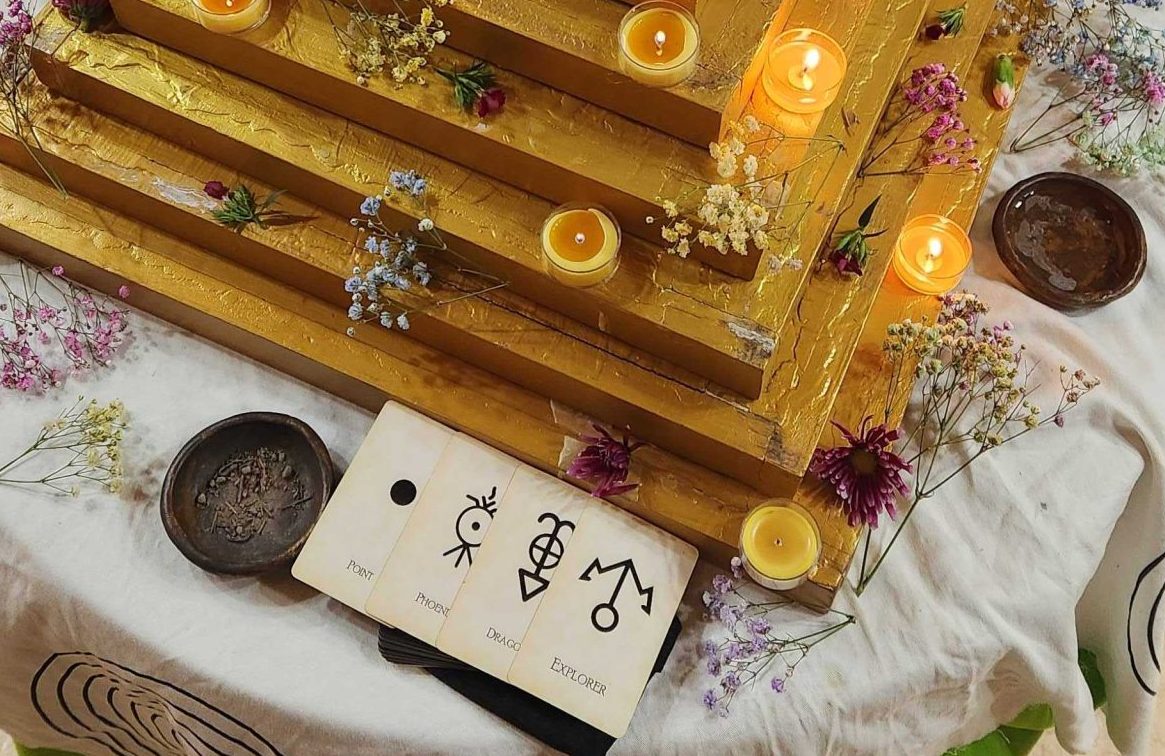
‘Quintessence’ is a term that means ‘the fundamental essence of a thing’. It suggests a distillation; a honing of a thing down to its very core, its most essential parts. The working of our rite on this Spring Equinox was a group exercise, a contemplation about that word. I invite you to think on these ideas yourself, as I reiterate the path we walked.
When you think of the quintessence of an object or a tool, it can be easy to recognize. A tool can be condensed to the task it performs; furniture is for sitting at or using; food is for eating. The platonic ideal of a shape could be its quintessence. What, then, about the quintessence of a person? Of you? That is a much more complicated question, no? Imagine that for yourself: How would you describe the core aspect of your being? An emotion? a fervent desire? A hope you wish to make manifest? A singular moment you wish to reflect in your being?
Whatever you find, there is beauty in it, surely…and yet, it’s nearly impossible to neatly encapsulate all of yourself into one idea. Think of a part of you that doesn’t fit into that quintessence, and yet, still is important. The secondary passion, the aspect of you that you grew into: The writer and storyteller may also love to cook. Consider it, truly:
What aspects, what passions, what parts of yourself would you have to cut away outside of your quintessence? Are those aspects less valuable?
Energetically, there is merit to the act of winnowing: The Guardian’s tool is the scythe, which- along with the planetary connection to Saturn- energetically symbolize the act of contraction, of drawing intention inward. This draws energies to a singular point, so that which we preserve grows stronger. Much like with plants, you have to cut away dead growth so that the other branches grow stronger. Sometimes, the parts that we trim even directly contradict your core. Were some of those aspects in opposition to your quintessence? The core of one queer person might be selfless love, and yet, along the way they found a hard-won lesson of learning to care for themself.
All of this is to say that people are different from plants and tools. We’re complex and messy things! We contain multitudes! Sometimes those aspects are contradictory! And all this is wonderful. We strive to be open-hearted to each other, to offer space for every aspect we offer to bear to one-another in our talkings, our dealings, our beings.
So what about our spirits, our deities, our gods?
In our workings, when we turn to the Queer Divine, they wear their quintessence on their sleeve: There’s a name and a virtue- and often they’re the same thing. The Lover’s quintessence is Love, that’s obvious. So when tries to pray to the Lover, to reach out to them, they might only imagine the visage of a tender soul, of gentle hands and a kind, intimate touch, of the embrace of one whose most fervent desire is love. But if we only see them in that single dimension, we winnow out so many possibilities.
All of this is to say, then:
Open-heartedness also means being open to the possibilities that our spirits might approach us with.
Several of us recounted some of the most profound interactions with unexpected shapes of the Queer Divine.
One recounted the first time they saw the Liberator – who.was once the Androgyne – wearing dress pants instead of a skirt. Another had met the Healer, battered and exhausted, head in his hands, having done their best and still having failed. One meeting of the Explorer was with a bookworm, who hadn’t seen outdoors but knew every path and story through plot and narrative. Another saw the Youth and Explorer as a duo, two best friends back from a voyage out in the woods. The Minotaur sometimes has shown neither as stoic guardian nor monster, but as a gardener and steward. That Minotaur might not interfere in the voyage of the Labyrinth, but if one needs rest or cannot continue the journey, they would be there to carry them back to safety.
As a fundamentally Queer tradition, we aspire to be free of any dogma: There is no single prescribed appearance of any one of the Queer Divine. Thus, it is vital then that we leave room to be open to their possibilities. As Scribe, I aspire to use my term to better record and preserve the many faces and facets our spirits wear when we meet and work with them. This is how a tradition grows: By refusing to calcify into fixed habits, we can invite new lessons, new depth, new richness to the spirits, and the workings with both them and each other.
We are of the Phoenix, after all: Ever we are allowed the ability to transform, to grow anew, and to be open to the wonder that exists in all of us.
Ta kya te (my heart is open to you),
Your humble Scribe,
Elluim